Pre-med and college baseball are fighting over the same hours. Organic chemistry labs, MCAT prep, clinical volunteering, and research positions all demand time that practice and travel weekends want too — and at most D1 programs, baseball wins that fight. The D2 and especially D3 levels are where the math works: shorter seasons, lighter travel, and a set of schools whose pre-med ecosystems are genuinely elite.
This is the second ranking in our Academic Baseball Fits series, after engineering. Same philosophy: academics first, baseball as the eligibility requirement, not the product.
How We Ranked These Schools
One framing point before the weights: pre-med is not a major. Medical schools accept applicants from any field of study — the AAMC is explicit that you don't have to major in a science — as long as the prerequisite coursework, GPA, MCAT, and clinical profile are there. So we didn't rank "pre-med programs." We ranked pre-med environments: everything around an athlete that makes a medical school application come together over four years.
Four things carried the scoring. Pre-health advising strength counted most (35%) — dedicated pre-health advisers, committee letter support, and structured application guidance. The science and research ecosystem came next (25%): biology, chemistry, neuroscience, and real undergraduate research access. Clinical exposure was 20% — hospitals, medical schools, and shadowing/volunteering ecosystems an athlete can actually reach on a practice schedule. Baseball itself was a 15% factor (current D2/D3 varsity program, conference quality, recent NCAA relevance), and brand recognition got 5% — deliberately small, because a name parents recognize doesn't write a committee letter.
Two things we refused to score. We did not use med-school acceptance rates — most published rates are self-selected, committee-filtered, or otherwise cherry-picked, and comparing them across schools rewards the schools that screen hardest. And as always: this is not a recruiting target list. It says nothing about which of these programs needs a shortstop in your athlete's class year — that's a separate question, and it's the one that decides recruitments.
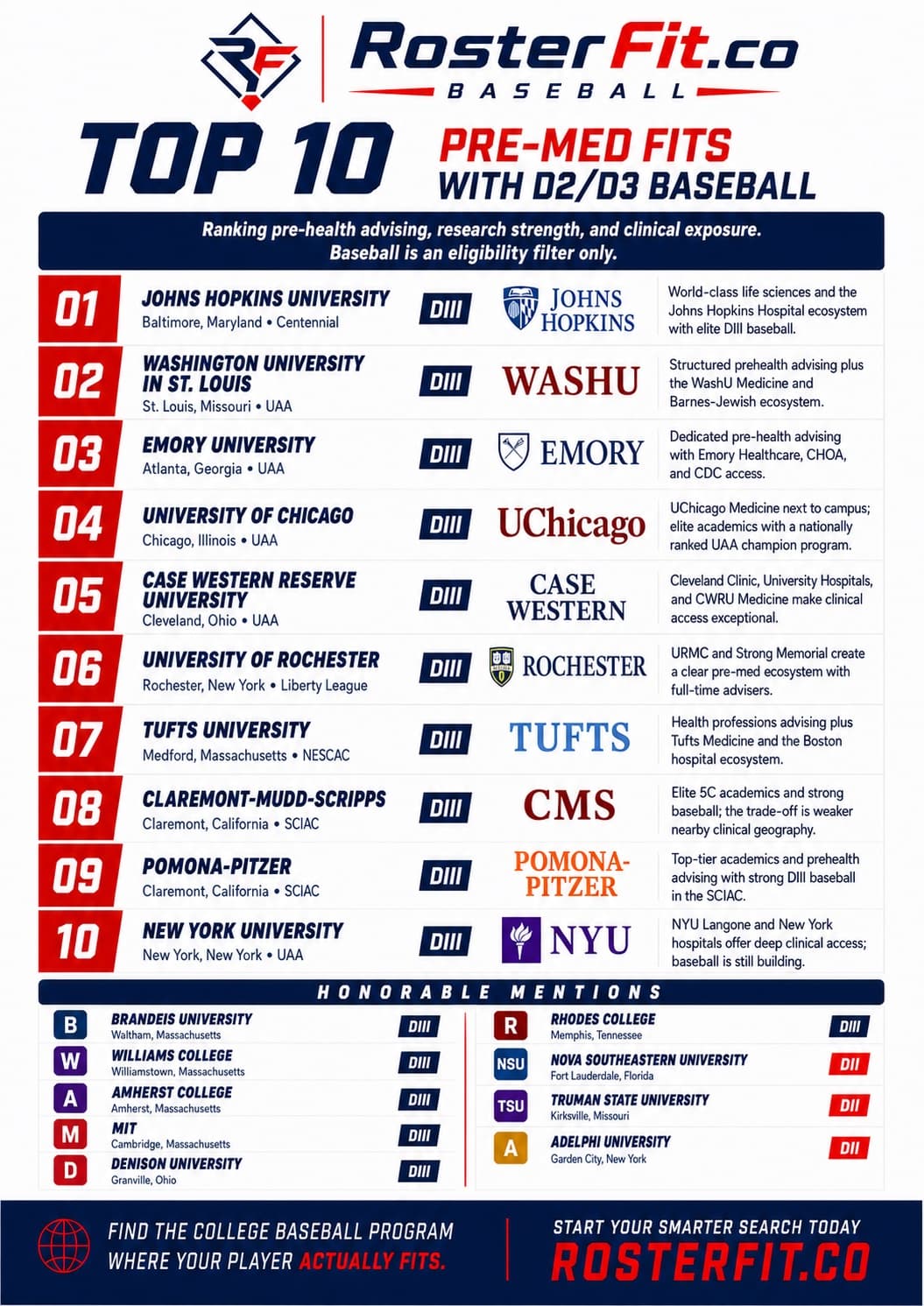
The 10 Best D2/D3 Baseball Schools for Pre-Med
1. Johns Hopkins University — D3, Centennial
The rare school where both halves are elite. Hopkins pairs world-class life sciences and the Johns Hopkins Hospital ecosystem with dedicated pre-professional advising — and the baseball is among the best in D3, with a trip to the 2026 Division III College World Series. For an athlete pointed at medicine, biomedical research, or public health, this is the anchor of the list.
2. Washington University in St. Louis — D3, UAA
A top-tier pre-med environment by every measure: structured prehealth advising, elite sciences, and the WashU School of Medicine / Barnes-Jewish ecosystem for research and clinical exposure. The UAA gives baseball players a peer group of athletes at similarly demanding schools — half of this top ten plays in it.
3. Emory University — D3, UAA
Emory's dedicated Pre-Health Advising office supports students and alumni through the full application cycle, and the surrounding ecosystem is hard to beat: Emory Healthcare, Children's Healthcare of Atlanta, and the CDC are all part of the same metro. One of the best blends of advising, clinical access, and DIII baseball anywhere.
4. University of Chicago — D3, UAA
UChicago Medicine and the Pritzker School of Medicine sit directly adjacent to campus, and the university's Careers in Healthcare pathway provides cohort programming and application advising. The baseball just caught up to the academics: the Maroons won the 2026 UAA title — the program's first conference championship in 113 years — and earned a second straight NCAA tournament bid while nationally ranked. One honest note: UChicago's grading rigor is real, and GPA matters to med schools.
5. Case Western Reserve University — D3, UAA
No school on this list has better clinical geography: the Cleveland Clinic and University Hospitals are effectively part of the campus neighborhood, alongside CWRU's own School of Medicine. Case also offers one of the few true direct-admit medical pathways in the country (the Pre-Professional Scholars Program), and the baseball is legitimate — a recent UAA champion that entered 2026 nationally ranked.
6. University of Rochester — D3, Liberty League
Rochester has one of the clearest pre-med ecosystems anywhere: the University of Rochester Medical Center and Strong Memorial Hospital are on-campus assets, full-time pre-health advisers handle the application process, and the Rochester Early Medical Scholars program is one of the most established BA/MD pathways in the country. Note the conference: Rochester plays its baseball in the Liberty League, not the UAA.
7. Tufts University — D3, NESCAC
Tufts pairs dedicated health professions advising — including one-on-one application support — with its own medical school and Boston's research and hospital ecosystem. NESCAC baseball is consistently among the strongest high-academic conferences in D3, which makes Tufts one of the most complete fits here.
8. Claremont-Mudd-Scripps — D3, SCIAC
The combined team of Claremont McKenna and Harvey Mudd (Scripps is women-only), with sciences delivered through the Keck Science Department and Mudd's own programs. The academics are elite, and the baseball is the best-kept secret in this top ten: CMS reached back-to-back NCAA Super Regionals in 2025 and 2026, taking on Johns Hopkins in the latter. The trade-off is clinical exposure — Claremont has no academic medical center, so shadowing and clinical hours take a car.
9. Pomona-Pitzer — D3, SCIAC
Pomona's prehealth advising helps students sequence coursework, find research, and build clinical experience, and the academic peer group is as strong as any school on this list. The Sagehens are also only a year removed from the Division III College World Series. Like its Claremont rival, the limiting factor is clinical geography rather than anything on campus.
10. New York University — D3, UAA
NYU's case is the ecosystem: NYU Langone and the density of New York hospitals put clinical exposure, research, and volunteering within a subway ride. The honest caveats are structural — advising at NYU's scale is stretched thinner than at the small schools above it, and the baseball program, restarted in 2015, is still building. The brand is bigger than the rank; the pre-med environment is exactly this good.
Honorable Mentions
Several more schools belong on a pre-med recruit's long list. Brandeis (D3, UAA) has a dedicated pre-health advising office and the Boston-area ecosystem. Williams and Amherst (D3, NESCAC) place students into medical schools at elite rates — what keeps them off the top ten is clinical geography, not academics. MIT (D3, NEWMAC) offers unmatched research depth for an athlete who wants the harder road. Denison (D3, NCAC) pairs a strong liberal-arts pre-med culture with the best baseball on this page — the No. 1 seed at the 2026 D3 College World Series. Rhodes(D3, SAA) has a longstanding research partnership with St. Jude Children's Research Hospital in Memphis. On the D2 side, Nova Southeastern(Sunshine State) is the standout — its own MD and DO colleges on campus plus one of D2 baseball's best leagues — alongside Truman State (GLVC), a low-cost pre-med value, and Adelphi (NE10), with the New York metro hospital ecosystem.
What Baseball Families Should Take From This List
- The admit is the hard part, and baseball can help. At high-academic D3s like these, coach support in admissions is real but limited leverage. A strong transcript plus genuine coach interest gets athletes into schools their grades alone might not — but only if the coach actually wants you, which is a targeting problem.
- For pre-med, the D3 schedule is a feature, not a consolation. D3 offers no athletic scholarships, but its shorter season and lighter travel are precisely what afternoon labs, MCAT prep, and clinical hours require. The D2s here can put athletic money behind an offer — at the cost of a longer, more demanding baseball calendar. That trade-off deserves an honest family conversation.
- This list is not a target list. Ten schools ranked by pre-med environment says nothing about which ones need a left-handed arm in 2028. Academic fit narrows the universe; roster need and recruiting timing pick the targets. Our NCAA recruiting guide covers how D2 and D3 contact rules work — both far more open than D1.
Pre-Med and College Baseball FAQ
Can you play college baseball and be pre-med?
Yes — athletes do it every year, but division choice is most of the battle. The prerequisite sequence (biology, general and organic chemistry, physics, biochemistry) is lab-heavy and unforgiving, and D3's shorter season leaves meaningfully more room for it than D1's. The realistic plan also uses the off-season: summers are when clinical hours, research, and MCAT prep happen.
Do medical schools care that you played a varsity sport?
Yes, positively — admissions committees read four years of varsity athletics as evidence of discipline, time management, and teamwork, and it strengthens the activities section of an application. But it never substitutes for the core numbers: GPA, MCAT, and clinical experience come first, which is exactly why the schedule fit on this list matters.
Should a pre-med player choose D2 or D3?
D3 if the academics and aid work: no athletic money, but academic and institutional aid at these schools can be substantial, and the time math favors pre-med. D2 if scholarship money is the constraint — just go in clear-eyed that the baseball commitment is bigger, and ask hard questions about how the program's current players handle lab-heavy majors.
Which of these programs actually needs your athlete?
RosterFit Baseball maps 1,800+ programs — including every school on this list — by roster need, academic fit, and admissions reality, and delivers a targeted list of 20–25 programs worth pursuing. Delivered within 24 hours.
Get your report — $149