"Business-minded" is not a single major. The high schooler who wants investment banking, the one drawn to startups, and the one who lights up over data and analytics are pointed at different majors (finance, entrepreneurship, economics, accounting, management) but at the same kind of career. So this ranking doesn't reward schools for happening to print the word "Business" on a diploma. A top economics department that feeds Wall Street counts every bit as much as a formal undergraduate business school. Two of those paths now have their own rankings, built on different evidence than this one: accounting and data science and analytics.
This is the third ranking in our Academic Baseball Fits series, after engineering and pre-med. Same philosophy: academics first, baseball as the eligibility requirement, not the product.
How We Ranked These Schools
Three signals carried the order. Business-minded academic strength counted most, and we read that broadly: a formal business school, a deep economics department, and strong finance, accounting, entrepreneurship, or analytics offerings all earn full credit, with no premium for the "Business" label itself, including the room to combine any of it with STEM, policy, or pre-law. Career outcomes and employer access came next: finance, consulting, and startup placement, the alumni network that opens those doors, and the internship geography that feeds them: New York, Boston, Chicago, Atlanta, St. Louis, and Southern California all do real work for a business career. Selectivity was the third, as the student side of the equation.
A word on sources. U.S. News does publish an undergraduate business ranking, and we use it where it applies: MIT is #1 on that list and NYU is #5. But it cannot carry this article, for two reasons the ranking itself states. It is built solely from a peer-assessment survey, so it measures reputation among business deans and nothing else. And a program must be accredited by AACSB International even to appear on the survey, which means four of the ten schools below can never be on it at all, because they have no undergraduate business school: Chicago, Claremont McKenna, Williams, and Amherst send graduates into finance and consulting through economics departments instead. Ranking on the AACSB list alone would have deleted them from consideration. So we use it as one input and assess economics depth directly everywhere it doesn't reach.
One caveat on the internship geography inside that second signal: it mostly reflects finance internships, which cluster in big cities. Consulting recruiting works differently: McKinsey, Bain, BCG, and the Big Four recruit on target campuses and place graduates nationally, so it is largely location-independent. That narrows the disadvantage for the rural liberal arts colleges further down this list, which are quietly some of the better consulting feeders here.
Baseball was an eligibility filter, not a ranking factor, and it was division-blind. A school had to sponsor varsity baseball at the NCAA Division II or Division III level to qualify (a simple yes/no check), and beyond that, division played no role. We did not add, elevate, or reserve slots for D2 schools to "represent" the division. The honest result is a list that skews D3, because that is where the strongest business academics among baseball schools actually sit.
The filter is binary, and it has teeth. One school that would have made this top ten doesn't appear at all: Carnegie Mellon's Tepper School ranks #6 in the country on the U.S. News undergraduate business list, but Carnegie Mellon does not sponsor varsity baseball, so it fails the eligibility check, full stop. There is also one thing this list deliberately is not: a recruiting target list. It says nothing about which of these programs needs an infielder in your athlete's class year. That's a separate question, and it's the one that decides recruitments.
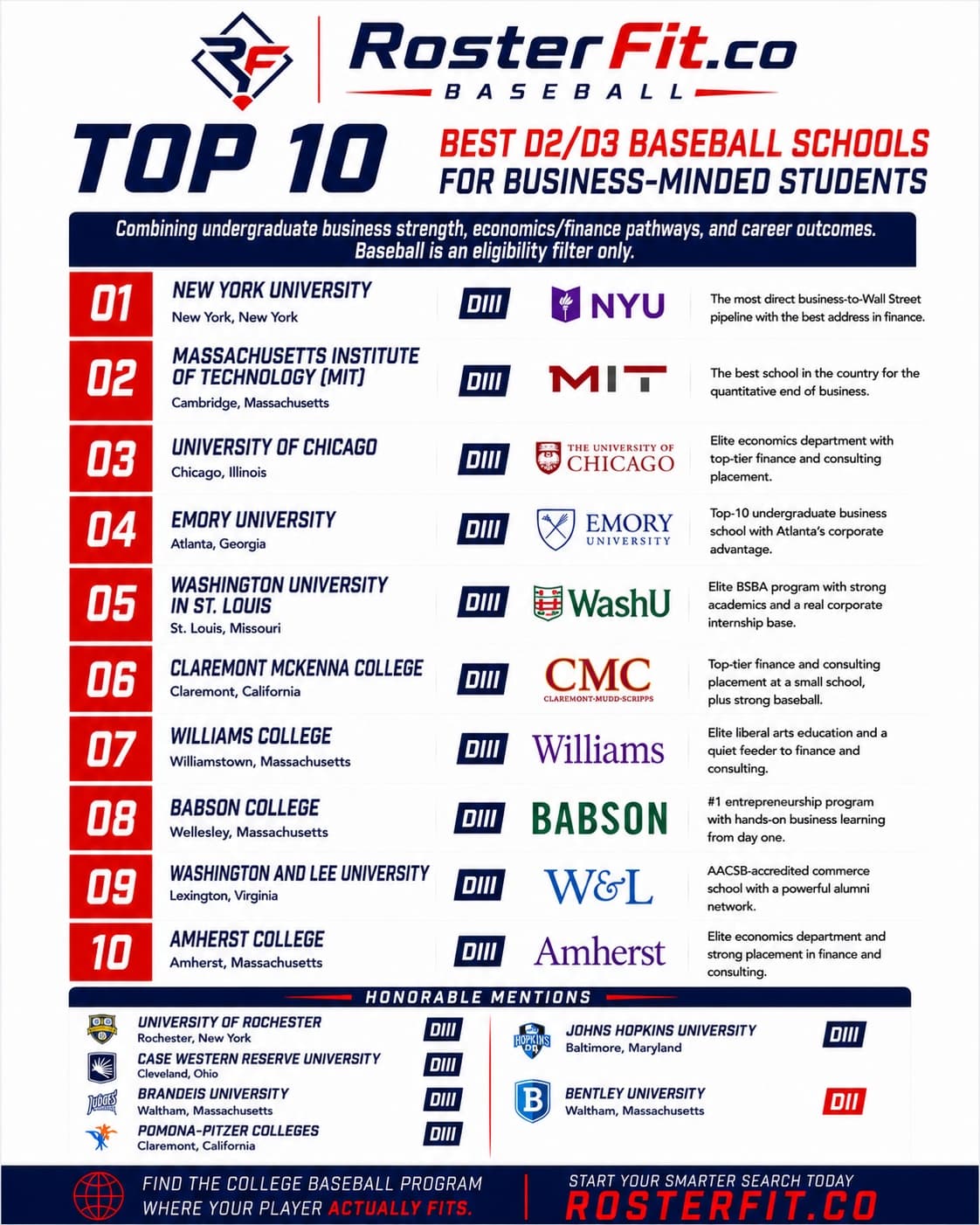
Save or share this ranking, send it to a teammate's family.
The 10 Best D2/D3 Baseball Schools for Business-Minded Students
1. New York University: D3, UAA
Stern is the most direct business-to-Wall-Street pipeline on this list, and it comes with the best address in finance. The undergraduate BS in Business is STEM-eligible and built on a core of business fundamentals, global business, and the liberal arts; Poets&Quants ranked it No. 6 nationally in 2026. The location does double duty: internships, alumni, and recruiting all sit a subway ride away. The honest caveat is the same one from our pre-med list: NYU is big, and advising is more self-serve than at the small schools below. The baseball program, restarted in 2015, is still building in the UAA.
2. Massachusetts Institute of Technology: D3, NEWMAC
MIT Sloan offers undergraduate majors in Management, Business Analytics, and Finance, and it is the best school in the country for the quantitative end of business: analytics, quant finance, operations, and tech entrepreneurship. The brand and outcomes are unmatched. One expectation to set: Sloan's undergraduate program is small and quant-heavy, not a broad, traditional BBA experience, and it rewards a student who likes the math of business. Baseball is NEWMAC, a strong academic D3 league.
3. University of Chicago: D3, UAA
The biggest beneficiary of how we rank this list. Chicago has no undergraduate business major, but its economics department is among the best in the world, and finance is the single most common career path for its economics majors, with consulting close behind. Placement into investment banking, consulting, and quant roles rivals any formal business school here. The Maroons also just won the 2026 UAA baseball title, program's first conference championship in 113 years. The trade-off is grading rigor: the academics are demanding, by design.
4. Emory University: D3, UAA
Goizueta is a dedicated undergraduate business school: accounting, finance, information systems and operations, marketing, and management, and Poets&Quants ranked it No. 10 nationally in 2026. Atlanta is the multiplier: Coca-Cola, Delta, Home Depot, and a deep corporate base put internships and recruiting in the same metro. Note the structure (students typically enter the BBA after their first two years), and the baseball is solid DIII in the UAA.
5. Washington University in St. Louis: D3, UAA
Olin's BSBA spans eight majors, including finance, accounting, economics and strategy, entrepreneurship, marketing, and operations and supply chain, and it lands just outside Poets&Quants' national top ten. The academics and selectivity are elite, the UAA gives baseball players a peer group at equally demanding schools, and St. Louis offers a real corporate internship base. A complete business-and-baseball fit.
6. Claremont McKenna College: D3, SCIAC
CMC punches far above its size for finance and consulting. The Robert Day School offers Economics, Economics-Accounting, and a Financial Economics Sequence built specifically for students headed into finance or graduate study, and the school's Wall Street and consulting placement is among the best of any liberal arts college in the country. On the field it plays as Claremont-Mudd-Scripps (CMS) in the SCIAC, quietly one of the better academic D3 baseball programs, with back-to-back NCAA Super Regional appearances in 2025 and 2026.
7. Williams College: D3, NESCAC
The best pure liberal arts college on this list, and a quiet finance and consulting feeder. Williams has no business major, but its economics department is elite and its alumni network places graduates into banking, consulting, and asset management at rates that embarrass many formal programs. NESCAC baseball is among the strongest high-academic conferences in D3. The limiting factor is location: rural Massachusetts is a drive from any financial center, so finance internships lean on the summer. It matters far less for consulting, which recruits on campus and places nationally, one reason Williams is a stronger consulting feeder than its zip code suggests.
8. Babson College: D3, NEWMAC
The most business-focused school here, and the No. 1 program in the country for entrepreneurship for nearly three decades running. Every Babson undergraduate takes Foundations of Management and Entrepreneurship and helps run a real business in year one; the model is business fused with the liberal arts rather than bolted onto it. The trade-off is the flip side of that focus: less academic breadth than the universities above it, which is exactly why it sits here rather than higher. Baseball is NEWMAC, just outside Boston.
9. Washington and Lee University: D3, ODAC
W&L is one of the very few top liberal arts colleges with a nationally accredited (AACSB) commerce school, and its Williams School delivers business and economics inside a liberal-arts curriculum. The alumni network is the real asset: W&L places into investment banking and consulting, particularly across the Southeast and into New York, at a level its size would not predict. Baseball is competitive DIII in the ODAC.
10. Amherst College: D3, NESCAC
Amherst rounds out the list on the strength of an elite economics department and a dedicated Careers in Business and Finance program (the Traub program) that funnels students toward finance, consulting, startups, and entrepreneurship. Like Williams, the academics and placement are the draw and rural location is the only real constraint, and one that pinches finance far more than consulting, where Amherst recruits as well as almost anyone here. NESCAC baseball keeps the athletic side honest.
You've seen the 10 best. Which would actually recruit your athlete?
A strong business program only matters if the team has a roster need and your athlete clears admissions. RosterFit checks every school on this list, plus comparable business fits across all 1,500+ programs, and hands you the 20–30 worth pursuing.
Build my target listHonorable Mentions
Several more qualifying schools belong on a business-minded recruit's long list. University of Rochester (D3, Liberty League) moves its undergraduate business program into the Simon Business School in fall 2026, with BS tracks in finance, entrepreneurship, and business analytics. Case Western Reserve (D3, UAA) offers seven business majors through Weatherhead, from finance and accounting to business analytics. Brandeis (D3, UAA) pairs an undergraduate business major with a strong economics department and the Boston ecosystem. Pomona-Pitzer (D3, SCIAC) brings an elite liberal-arts economics program on the strength of Pomona's department. Johns Hopkins (D3, Centennial) is better known for STEM, but its financial-economics pathway and analytics depth make it a real option for the quant-minded. And on the D2 side, Bentley (Northeast-10) is the standout business school of the level: 98% of its Class of 2025 was employed or in graduate school within six months, at a record $75,000 median starting salary.
What Baseball Families Should Take From This List
- The major matters less than you think. For business-minded careers, finance, consulting, banking, a top economics degree opens the same doors as a formal BBA. Don't cross a great school off the list just because it lacks a major literally called "Business."
- Summers carry the internship load. Baseball's spring season overlaps the spring recruiting and internship calendar, so for a student-athlete the summer internship (and a major you can schedule around a travel-heavy season) does most of the career-building work. Ask a program's current players how they manage it.
- This list is not a target list. Ten schools ranked by business fit says nothing about which ones need an infielder in 2028. Academic fit narrows the universe; roster need and recruiting timing pick the targets. Our NCAA recruiting guide covers how D2 and D3 contact rules work, both far more open than D1.
Business and College Baseball FAQ
Can you play college baseball and major in business?
Yes. Business and economics majors schedule around a season more easily than lab-heavy sciences. The catch is timing: spring, the heart of baseball season, is also peak internship and recruiting season, so for a student-athlete the summer internship does most of the career-building work. D2 and especially D3 schedules leave meaningfully more room for it than D1.
Do you need a business major to break into finance or consulting?
No. Investment banks and consulting firms recruit heavily from economics majors, and at schools like Chicago, Williams, and Amherst, economics is the primary feeder into those careers. What matters more than the major label is the school's recruiting access and alumni network, which is why this ranking weights economics and career outcomes as heavily as a formal business degree.
Are these schools good for consulting, not just finance?
Yes, arguably more so. Management consulting firms like McKinsey, Bain, and BCG, along with the Big Four, recruit across majors and prize analytical reasoning and communication over a finance pedigree, so a history or biology major from a target school competes on even footing. Consulting recruiting is also campus-based rather than city-based: firms recruit on target campuses and place graduates nationally, so the rural location that limits finance internships barely matters. That makes the elite liberal arts colleges here (Williams, Amherst, and Pomona) along with Chicago, MIT, and Claremont McKenna, some of the strongest consulting feeders on the list.
Should a business-minded player choose D2 or D3?
Mostly an aid-and-fit question. The strongest business academics among baseball schools cluster in D3, which offers no athletic money but often substantial academic and institutional aid. D2, where Bentley is the standout, can put athletic scholarship behind an offer, at the cost of a longer baseball calendar. Pick the environment that fits the career, then solve the money.
This list has 10 schools. Your athlete's list should have 20–30.
These are the academic standouts, but not all 10 are realistic for every player. RosterFit Baseball checks all 1,500+ programs by roster need, academic fit, and admissions reality, then delivers the 20–30 actually worth your athlete's time.$49 one-time, delivered within 1 business day.
Get your report: $49