Most academics-first recruiting advice points families toward D2 and D3, and for good reason, because that's where elite academics and varsity baseball overlap most often. But there's a smaller, real set of schools where a great student doesn't have to trade down a level at all: programs that field Division I baseball and sit among the best universities in the country. This is the list for the athlete who has the tools for D1 and the transcript for anywhere.
It's ranked the same way as our other academic lists: by the school's academic standing, with Division I baseball as the filter, not a thumb on the scale. The Ivy League sits right at the top of that order, so the Ivies fill most of the main list. They just come with a scholarship caveat we flag on each one and explain below.
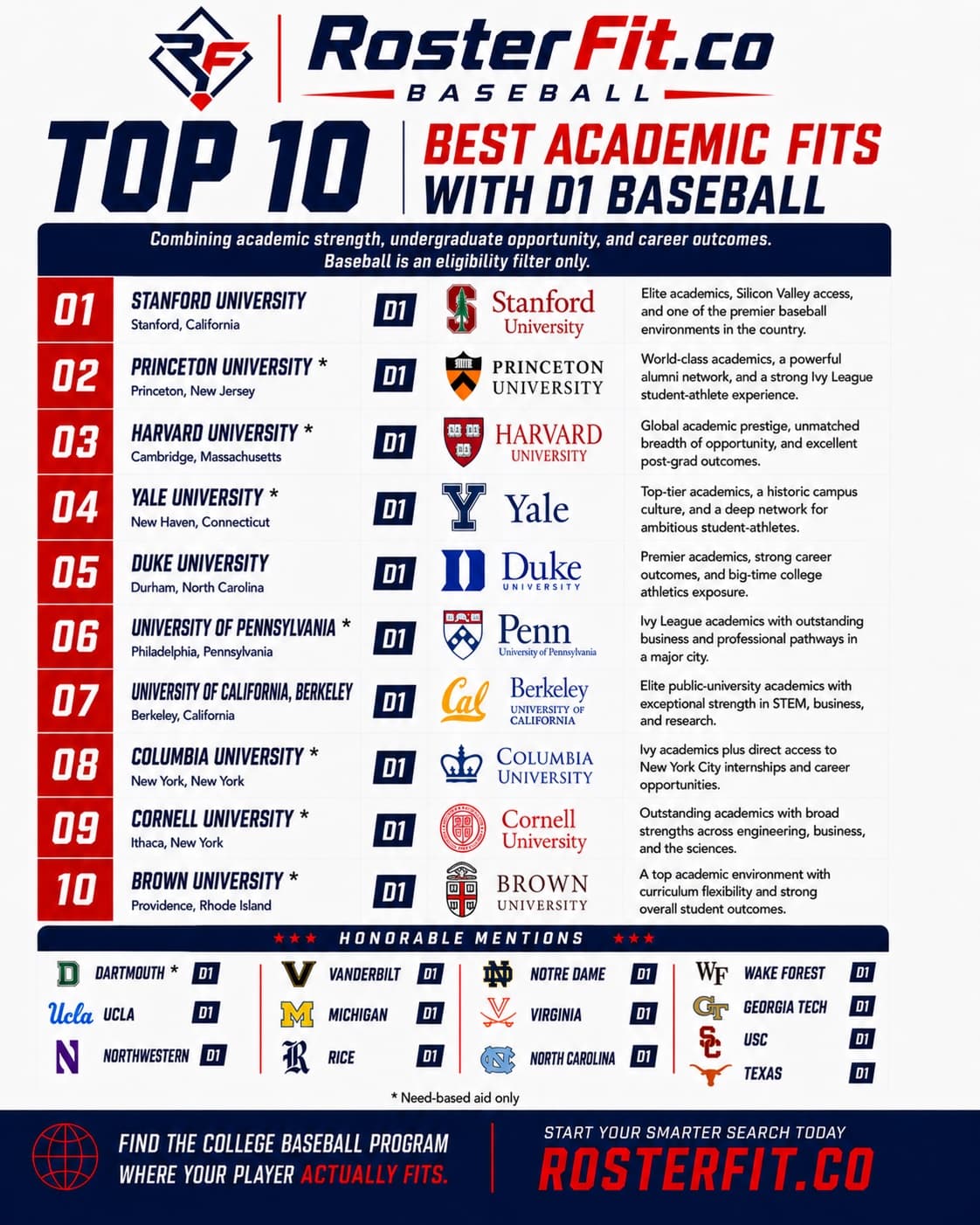
Save or share this ranking, send it to a teammate's family.
How We Ranked These Schools
The ranking is academics-first, and the order follows from it:
- Academic standing sets the tiers. Schools are grouped into academic tiers by overall reputation: peer assessment first, then selectivity, outcomes, and undergraduate strength. This is a reputation-led measure, not the resources-heavy U.S. News overall formula, which is why a public like UC Berkeley ranks among the elite here rather than well down the list.
- Division I baseball is the filter, then the tiebreaker. A school qualifies by fielding a D1 baseball program, and baseball never moves a school between academic tiers. Within a single tier, we break ties on baseball strength: conference quality and recent postseason history. Scholarship context (the Ivy League's need-based-only aid) is flagged on each school but doesn't affect the order.
A note on scholarships. Seven of the ten schools below are Ivy League, and the Ivy League offers no athletic scholarships, so all aid is need-based. We tag every Ivy with Need-based aid only so you can tell at a glance. For a qualifying family the aid can be excellent; for a full-pay family the same school can cost more than a stacked offer elsewhere. Only the three non-Ivy schools here, Stanford, Duke, and UC Berkeley, offer athletic scholarships.
The 10 Best Academic D1 Baseball Schools
1. Stanford University
Tops the academic order, and among schools this selective that also offer athletic scholarships, it has the deepest recent baseball pedigree: three straight College World Series trips from 2021 to 2023. The last three seasons have been leaner, with no NCAA tournament bid in 2024, 2025, or 2026 (28-26 in 2026), so the case rests on that ceiling and the scholarship model rather than current form. That combination still puts Stanford at No. 1.
2. Princeton UniversityNeed-based aid only
A co-leader of the academic order, and No. 2 in the 2027 U.S. News national ranking behind MIT, a perennial top-two school. Princeton plays Division I baseball in the Ivy League, so the aid is need-based only, with no athletic money, but the academic ceiling is the highest there is.
3. Harvard UniversityNeed-based aid only
Tied at the very top of the academic order, and the most recognized degree on the board. Like every Ivy, Harvard offers need-based aid only; for a qualifying family that aid is among the most generous in the country.
4. Yale UniversityNeed-based aid only
A half-step back from the top three academically, under the same Ivy League rules: need-based aid, no athletic scholarships. Yale baseball is a regular factor in the Ivy race, and the degree needs no introduction.
5. Duke University
An ACC program that became a regular in the NCAA tournament and reached multiple Super Regionals under Chris Pollard, who left for Virginia in June 2025. Corey Muscara took over for 2026, a season that ended without a tournament bid, so the program is in transition. Duke offers athletic scholarships, and the academics were never in question.
6. University of PennsylvaniaNeed-based aid only
Elite academics with a powerhouse pre-professional reputation, and historically one of the Ivy League's stronger baseball programs. Like its peers, need-based aid only.
7. University of California, Berkeley
Tied with UCLA as the top-rated public university in the 2027 U.S. News ranking, and its baseball profile within its academic tier is what lifts it into the top ten on the tiebreaker. Unlike the Ivies it ranks alongside, Berkeley offers athletic scholarships: elite academics at public scale.
8. Columbia UniversityNeed-based aid only
Elite academics in the middle of New York City, and Ivy League baseball with need-based aid only. A natural draw for the student who wants the city and the classroom as much as the diamond.
9. Cornell UniversityNeed-based aid only
The largest Ivy, with particular strength in engineering and the sciences. Strong STEM, Division I baseball, and the same need-based-only aid as the rest of the conference.
10. Brown UniversityNeed-based aid only
An Ivy League school whose open, student-built curriculum draws a specific kind of academic recruit. Academically even with its conference peers, it takes the final top-ten spot on the baseball tiebreaker. Need-based aid only, no athletic scholarships.
How does your athlete stack up at these schools?
Tap up to 3. We compare your athlete with the players each program took, using their high-school numbers, and show every player at their position the program took.
No card · Grad year, position, state, GPA · Empty slots can be any school, or Random
What Baseball Families Should Take From This List
The honest read: these schools ask your athlete to clear two of the hardest bars in college sports at the same time, a brutal admissions standard and a Division I recruiting standard. Plenty of D1-caliber players don't have the transcript; plenty of elite students don't have the tools. The athletes who land here have both, and they almost always started the academic side early.
Read the scholarship tags closely, too. Seven of these ten cost what your family's finances say they cost, not what your athlete's baseball is worth, so the same school can be a bargain or a budget-buster depending on need. For most strong students, the better odds (and often the better four years) are at the high-academic D2 and D3 programs where the same kind of education comes with a real path to the lineup. Our rankings of the best D2/D3 baseball schools for engineering and pre-med show how strong those outcomes can be, and our guide to D1 baseball recruiting covers whether D1 belongs on the list at all.
Honorable Mentions
Dartmouth is the eighth Ivy, academically even with the top of that tier but edged out of the top ten by the narrowest of baseball margins; it carries the same need-based-only aid as its peers. Just behind sit UCLA and Northwestern, both elite academically. Among schools with stronger baseball but slightly lower academic standing, the next tier is loaded: Vanderbilt, Michigan, Rice, Notre Dame, and Virginia are all excellent universities, several with elite baseball (think Vanderbilt's two national titles and Virginia's 2015 championship). Bigger baseball names than academic ranks include North Carolina and Wake Forest (the 2023 national No. 1 seed), while Georgia Tech, USC, and Texas pair strong academics with blue-blood baseball history.
Academic D1 Baseball FAQ
What is the most academically elite D1 baseball school?
On overall academic reputation, Harvard, Princeton, and Stanford sit at the very top of the schools that field Division I baseball, with the rest of the Ivy League close behind. Among schools that offer athletic scholarships, Stanford leads on academics and recent baseball history, followed by Duke and UC Berkeley.
Can you get an athletic scholarship to play D1 baseball at an Ivy League school?
No. The Ivy League does not offer athletic scholarships in any sport. Ivy financial aid is need-based only, so what you pay depends on your family's finances rather than on baseball. Recruited athletes still go through admissions with coach support, but the aid itself is not athletic, which is why we tag every Ivy on the list above.
Is it harder to get recruited at academic D1 baseball schools?
Generally yes, because a recruit has to clear two bars at once: the program's on-field standard and the school's admissions standard. At selective academic programs, coaches often run an admissions pre-read before investing in a recruit, so grades and test scores can widen or close the door before tools ever come into play.
Do strong academics help in D1 baseball recruiting?
Significantly. A strong transcript expands the list of programs that can recruit your athlete, gives high-academic coaches an admissions case to make on his behalf, and at some schools unlocks academic aid on top of any athletic offer. Academics are a recruiting asset at every level, and especially at the schools on this list.
Academic D1 Baseball FAQ
Do Ivy League baseball players get athletic scholarships?
No. The Ivy League offers no athletic scholarships at all, so every Ivy aid package is need-based. Seven of the ten schools on this list are Ivy, which is why the caveat is tagged on each one. For a qualifying family that aid can be excellent; for a full-pay family the same school can cost more than a stacked offer elsewhere. Only Stanford, Duke, and UC Berkeley here offer athletic scholarships.
Which school has the best combination of academics and D1 baseball?
Stanford, on our reading. It tops the academic order, it offers athletic scholarships, and it made three straight College World Series trips from 2021 to 2023. It has missed the NCAA tournament the last three seasons (2024 through 2026), so this is a bet on the program's ceiling rather than its current form, and Duke and UC Berkeley are reasonable alternatives among scholarship schools.
How is this list ranked?
Academics first. Schools are grouped into tiers by overall academic reputation, led by peer assessment and then selectivity, outcomes, and undergraduate strength. Division I baseball is the filter to qualify, never a thumb on the scale, and baseball never moves a school between academic tiers. Within a single tier, ties break on baseball strength: conference quality and recent postseason history.
Why does a public university rank alongside the Ivies here?
Because this list uses a reputation-led academic measure rather than the resources-heavy U.S. News overall formula. That formula systematically favors wealthy private universities, which pushes strong publics down the order for reasons that have little to do with the education. On a reputation-first reading, UC Berkeley belongs among the elite, and it ranks that way here.
Should a strong student target high-academic D1 or a top D3?
It depends on whether the athlete has D1 tools, not on whether he has the transcript. Most academics-first advice points families to D2 and D3 for good reason, since that is where elite academics and varsity baseball overlap most often, and our D3 recruiting guide covers how the money works there. This list exists for the narrower case: the athlete who has the tools for D1 and the transcript for anywhere, and therefore does not have to trade down a level at all.
How does your athlete stack up at Duke?
Start with Duke, then pick two more or let us pick, and see your athlete beside the players each one took. If the cards help, the full report ranks the 30 programs that fit.
No card. You'll need grad year, position, state and GPA; stats help but are optional. Your 3 school cards are usually ready in 10 to 20 minutes.